
Why Most Leadership Training Fails (And What Adult Development Offers Instead)
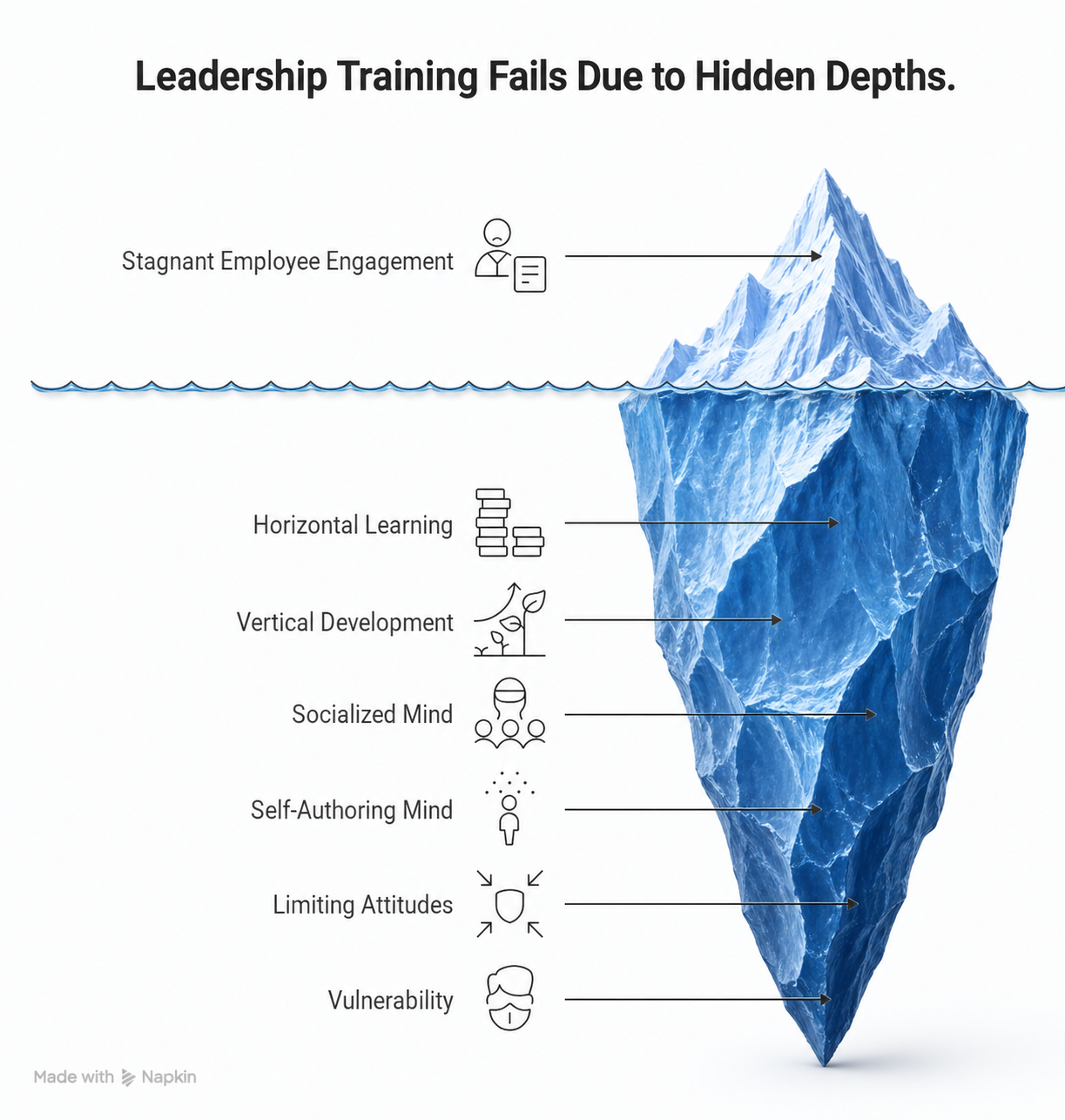
Most organizations are currently pouring money into a leaky bucket. Every year, billions are spent on leadership development programs, weekend retreats, and executive seminars. Yet, the data remains grim: employee engagement is stagnant, burnout is at an all-time high, and leaders feel more overwhelmed than ever.
The problem isn’t that the training is "bad." The problem is that we are trying to solve a 21st-century complexity problem with 20th-century tools. To understand why, we have to look at the fundamental difference between Horizontal Learning and Vertical Development.
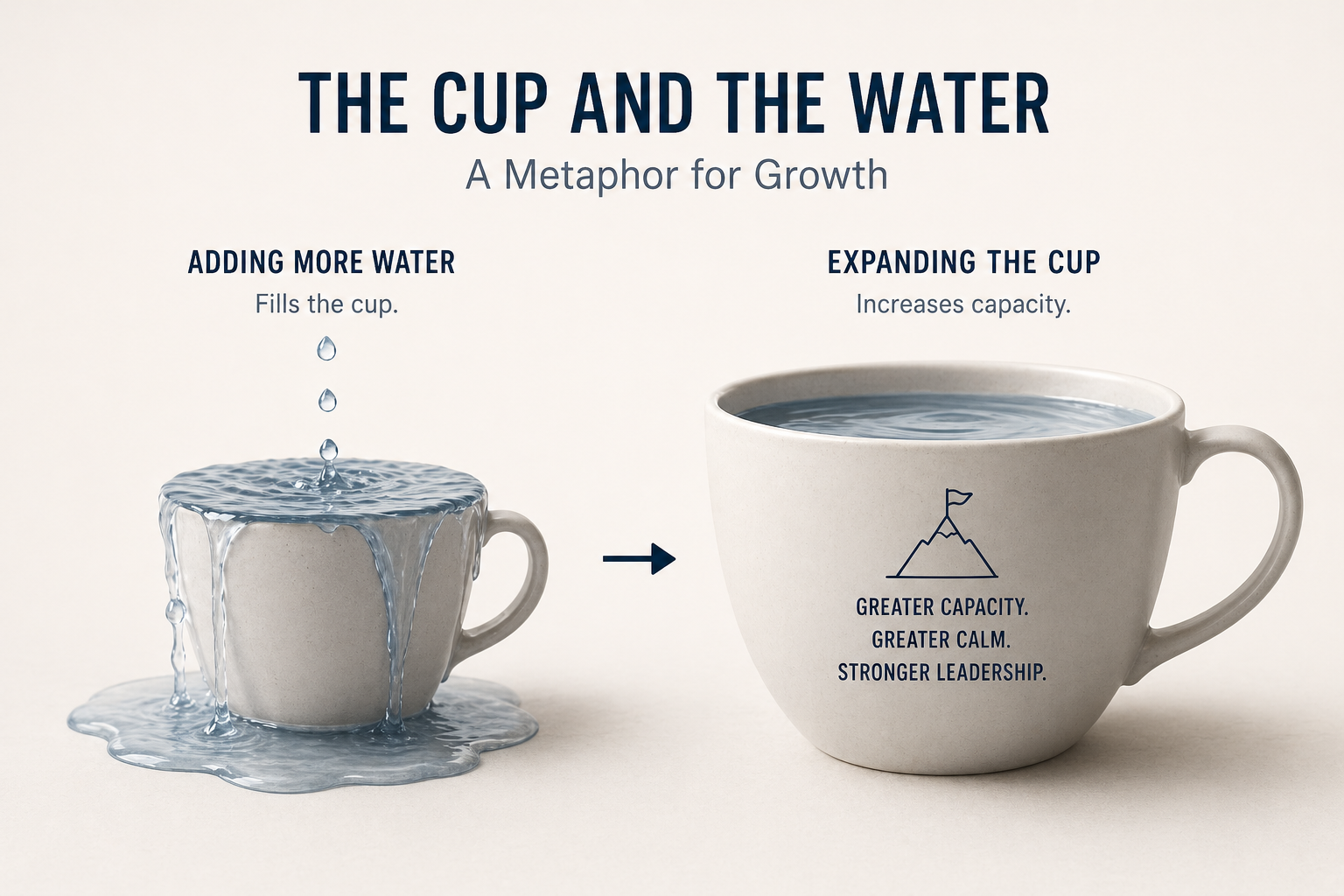
The Cup and the Water: A Metaphor for Growth
Imagine your mind is a cup. Traditional leadership training is focused on pouring more "water" into that cup. This is Horizontal Learning. It’s the acquisition of new skills, better time-management hacks, or a new framework for running meetings. While useful, this approach assumes the "cup" is already the right size and shape to handle the pressure.
The crisis of modern leadership is that the "water" (the complexity, the stress, the speed of change) is now overflowing. No matter how much more information you pour in, the leader cannot contain it.
Vertical Development—or Adult Development—isn't about the water. It’s about expanding the size and capacity of the cup itself. It is a transformation of the leader’s Operating System (OS), allowing them to hold more complexity, navigate deeper uncertainty, and remain present under fire.
The Psychological Shift: From Rules to Self-Authorship
We explore the stages of adult growth. Most leadership training is designed for what psychologists call the Socialized Mind. At this stage, a leader’s sense of "good" is defined by external rules, their peers' expectations, or the company culture. They are "team players," but they are also easily swayed by groupthink and paralyzed by a fear of "doing it wrong."
Adult Development pushes a leader toward the Self-Authoring Mind. This is a "Post-Conventional" stage where the leader is no longer a prisoner to external validation. Instead, they lead from a clear, internal "Relational Blueprint." They have the "Observing Mind" necessary to step back from the chaos and choose their response based on deep-seated values rather than reactive habits.
Training fails when it tries to teach "Self-Authoring" behaviors to a "Socialized" mind without doing the work to expand the person first. You cannot "hack" your way into wisdom.
The Biological Barrier: The Vagus Nerve and the 'Hijack'
There is a biological reason why you can't "learn" your way out of a crisis. When you are under extreme stress, your nervous system defaults to survival mode. In our framework, we call these the Limiting Attitudes: Pleasing, Protecting, and Controlling.
Traditional training tells you to "be empathetic" or "be decisive." But if your Vagus Nerve is sensing a threat, your brain will physically block access to those high-level skills. You become a "Protector" who shuts down or a "Controller" who micromanages.
Adult Development focuses on Physiological Regulation. It teaches leaders how to observe their own "Shadow Side" in real-time. By learning to regulate the nervous system, an enlightened leader prevents the "Limbic Hijack" from happening in the first place. You don't just know what to do; you are actually capable of doing it when the heat is on.
Why We Avoid the Real Work
If Vertical Development is so much more effective, why does the "Horizontal" model still dominate?
The answer is simple: Vulnerability.
Traditional training is "safe." You sit in a room, take notes, and go back to your desk. Adult Development is "No-Nonsense" work. It requires you to look in the mirror and acknowledge where your "Masks" are failing you. It requires the courage to admit that your current way of seeing the world is limited.
As we see in the Growth Cycle, real transformation only happens when we move through Review, Reflection, and Learning. Most training skips the reflection because it’s messy and uncomfortable. But without it, the "water" just keeps spilling out of the cup.
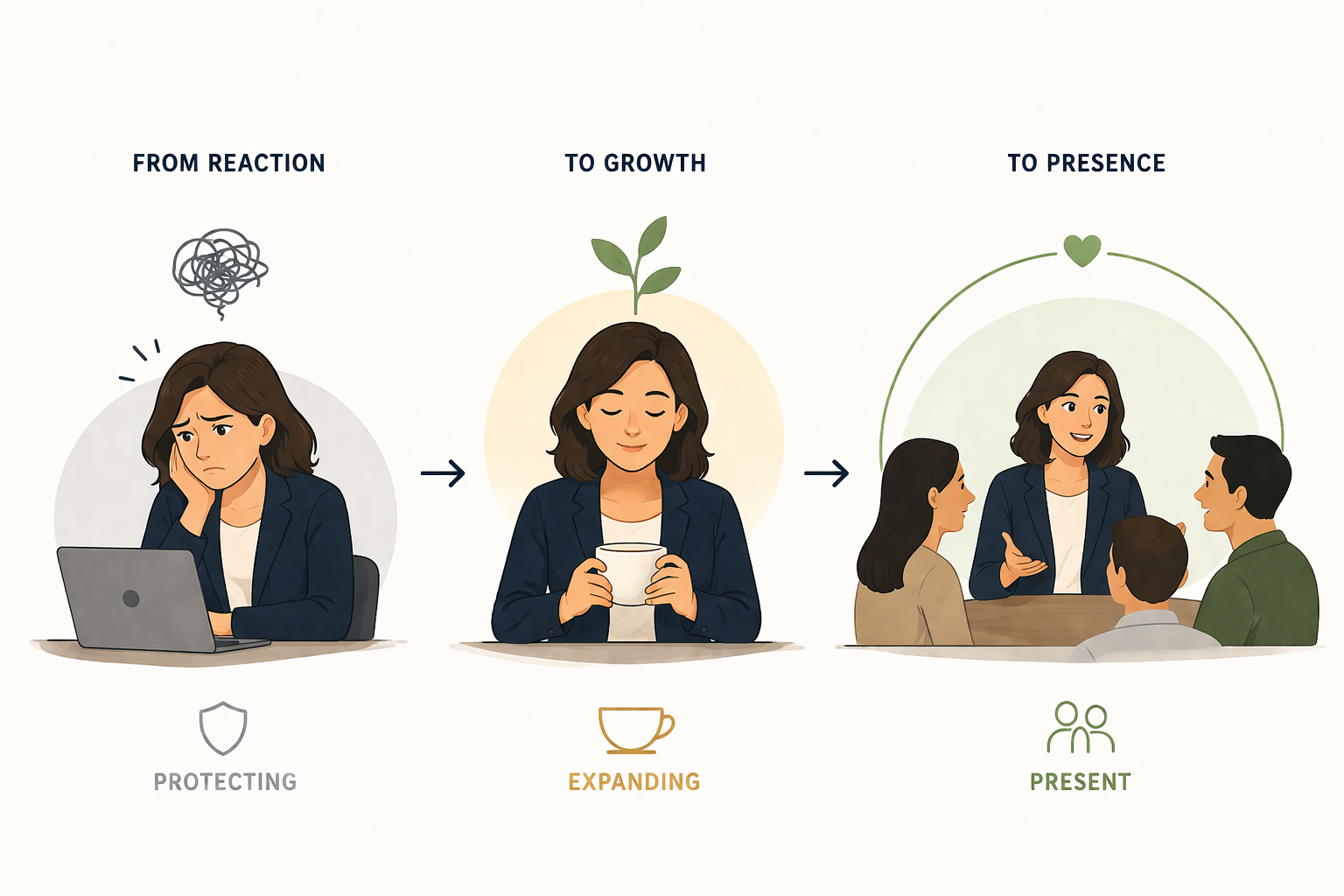
A Case Study in Vertical Growth: From Reaction to Presence
Consider a leader we'll call "Sarah." Sarah was a classic "Conventional" leader. She followed every management book to the letter, yet her team was disengaged. She spent $50,000 on leadership retreats, learning "Horizontal" skills like active listening and goal setting. Nothing changed because Sarah was still operating from a protective attitude; she used her expertise to keep people at a distance so she wouldn't be judged.
Through Adult Development, Sarah didn't learn a new "trick." She expanded her "cup." She did the Inner Work to recognize her fear of being wrong. She moved from a Socialized Mind (worried about looking like an expert) to a Self-Authoring Mind (focused on the team's collective growth).
When she stopped "Protecting" her ego, she became Authentic. Her team didn't need her to have a new framework; they needed her to be Present. Sarah didn't just get better at leadership; she became a bigger person.
Conclusion: Upgrade the OS, Don't Patch the Software
If you feel like you are "pinballing" through your day, reacting to every email and crisis, more "water" isn't going to help you. You don't need another hack, and you don't need another battle-picking strategy.
You need to commit to the Practice of Enlightened Leadership. This means moving beyond "Conventional" training and entering the world of Vertical Development. It means stopping the search for "software patches" and finally deciding to upgrade your Operating System.
The world is only getting more complex. It’s time to make your "cup" big enough to hold it.
