
How to Deliver Feedback That Actually Lands: Mastering the Art of Supportive Challenge

Effective leadership is fundamentally relational. Every strategic goal, every quarterly target, and every innovative breakthrough depends on the quality of the interactions between people. At the heart of these interactions is the "Feedback Conversation."
Yet, for many leaders, delivering feedback is the most daunting part of the job. We have all experienced the "Feedback Crash": you offer what you believe is a helpful suggestion, only to be met with a blank stare, a defensive rebuttal, or a total withdrawal from the team member. When feedback fails, it doesn't just stall performance; it damages trust and creates a "Relationship Gap" that can take months to repair.
True feedback that sticks isn't about finding the perfect script or a clever management "sandwich." It requires a profound alignment between your Inner Work—your internal state and motivations—and your Outer Work—your delivery and the relational safety you create.
The Inner Work: Checking Your "Mask" Before You Speak
Before you even open your mouth to deliver feedback, you must perform a radical internal audit. One of the primary reasons feedback fails is that the leader is "triggered" or operating from a reactive state. If you are subconsciously trying to protect yourself, your feedback will be felt as an attack, regardless of your word choice.
You must ask yourself: Am I speaking from an "Enlightened" state, or am I wearing a "Mask"?
The Pleaser Mask: If you are terrified of rejection or conflict, you will "sugarcoat" the message so much that the actual point is lost. You might think you are being kind, but by withholding the truth, you are denying the other person the chance to grow. This is "niceness" as a form of self-protection.
The Protector Mask: If you feel your authority is being questioned, you might deliver feedback from a place of "expert superiority." This often comes across as cynical, cold, or arrogant. The recipient doesn't feel supported; they feel judged by a stone wall.
The Controller Mask: If you are focused solely on the "It" (the result) and ignoring the "Us" (the relationship), your feedback becomes a lecture. You are using feedback to force compliance, which destroys the psychological safety required for a team to actually learn from their mistakes.
The Inner Pivot: An enlightened leader checks their intention. Is this feedback genuinely designed to help the other person expand their "cup," or is it just about you getting a frustration off your chest? If you aren't in a calm, regulated state, wait. Feedback delivered in anger or fear seldom lands.
The Outer Work: The High Support / High Challenge Matrix
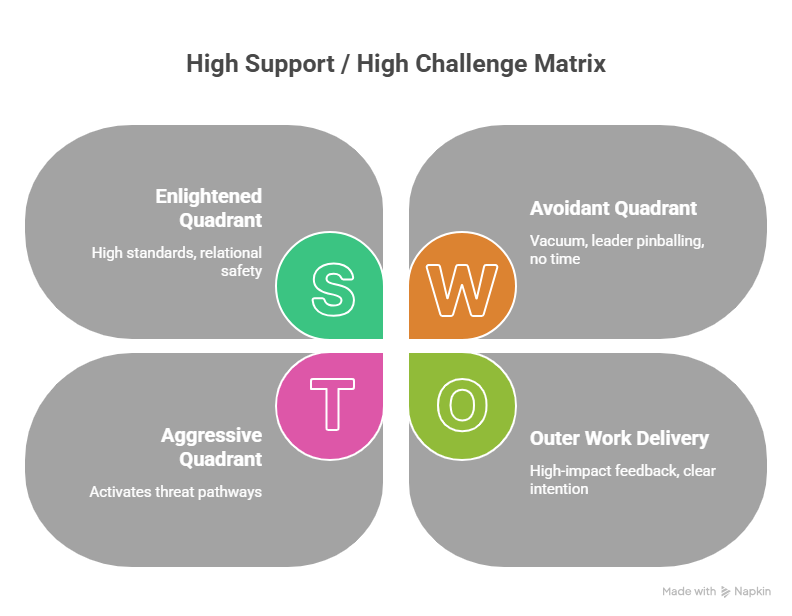
Once your internal state is regulated and your intention is clear, you can move to the "Outer Work" of delivery. High-impact feedback lives in a very specific psychological space: the intersection of High Support and High Challenge.
High Challenge / Low Support (The Aggressive Quadrant): This is where "Arsehole" leadership lives. You set high standards but offer no relational safety. This activates the "threat" pathways in the recipient's brain, leading to defensiveness or "Dead-Zoning."
High Support / Low Challenge (The "Nice" Quadrant): This is where the Pleaser lives. You are supportive and kind, but you avoid the "pebbles" and difficult truths. Performance stagnates because there is no "stretch."
Low Support / Low Challenge (The Avoidant Quadrant): This is a vacuum. The leader is "pinballing" so much that they don't have time for feedback. This is the most damaging state, as it leaves employees feeling invisible and directionless.
High Support / High Challenge (The Enlightened Quadrant): This is the goal. You hold the person to a high standard because you believe in their potential, and you provide the relational safety they need to face their gaps without shame.
The Practical Tool: The "Pebbles" Process
So, how do you move into that top-left quadrant? We recommend a process of "Clearing the Pebbles."
Most workplace friction starts as a "grain of sand"—a minor irritation, a late report, or a slightly off-tone comment. If left unchecked, that grain of sand rubs until it feels like a painful pebble in your shoe. Most leaders wait until the pebble has caused a blister before they say anything, leading to an explosion.
The BIC Model for Delivery: To keep feedback objective and non-judgmental, use the Behaviour-Impact-Consequence model:
Behaviour: "When you interrupted Sarah three times in the meeting..." (Stick to facts, not character traits).
Impact: "...it made it difficult for the team to hear her full proposal..."
Consequence: "...which means we might have missed a critical piece of data for the project."
The "HAT" Rule for Receiving: Feedback is a two-way street. To build a culture where feedback lands, the leader must also be an expert at receiving it. When you are on the receiving end, put your HAT on:
Hear: Listen deeply without preparing your defense.
Acknowledge: Acknowledge the other person’s perspective and the feelings they’ve shared.
Talk: Only after they feel heard do you offer your perspective or discuss the next steps.
The Role of the Vagus Nerve in Accountability
Feedback is a biological event. When we receive "High Challenge" feedback, our nervous system often perceives it as a social threat. Our heart rate increases, and our Vagus Nerve—the internal "brake" of our nervous system—can lose its grip.
An enlightened leader understands this biology. By maintaining a calm, warm presence and ensuring "High Support," you help the recipient stay in a "Rest and Digest" state. This keeps their prefrontal cortex online, allowing them to actually process and integrate the information you are giving them. If you see them starting to "flicker" into a threat response (becoming flush, stuttering, or shutting down), it is your job to dial up the support before continuing the challenge.
Case Study: The Rescue Trap
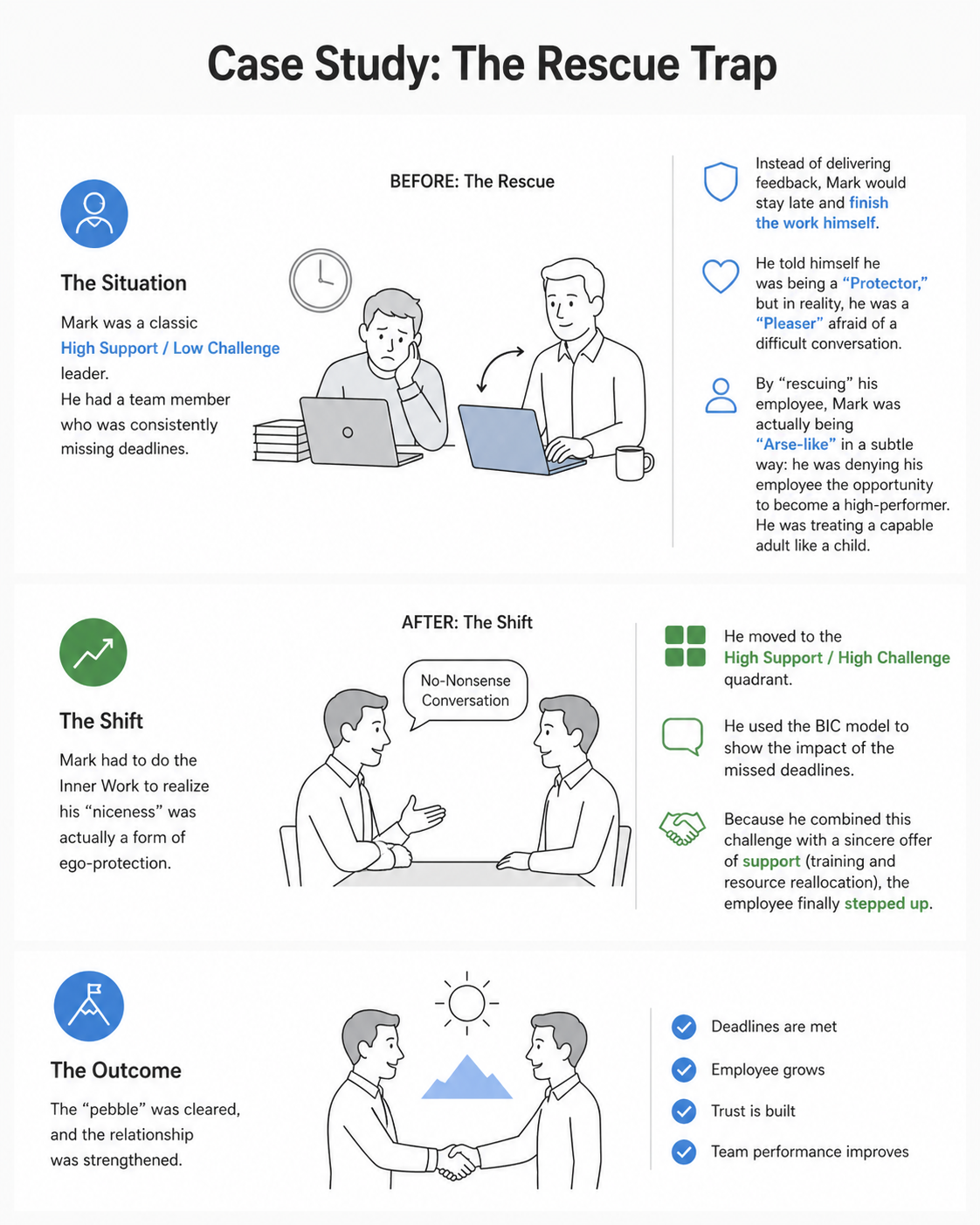
Consider a leader named "Mark." Mark was a classic High Support / Low Challenge leader. He had a team member who was consistently missing deadlines. Instead of delivering feedback, Mark would stay late and finish the work himself. He told himself he was being a "Protector," but in reality, he was a "Pleaser" afraid of a difficult conversation.
By "rescuing" his employee, Mark was actually being "Arse-like" in a subtle way: he was denying his employee the opportunity to become a high-performer. He was treating a capable adult like a child.
The Shift: Mark had to do the Inner Work to realize his "niceness" was actually a form of ego-protection. He moved to the High Support / High Challenge quadrant by having a "No-Nonsense" conversation. He used the BIC model to show the impact of the missed deadlines. Because he combined this challenge with a sincere offer of support (training and resource reallocation), the employee finally stepped up. The "pebble" was cleared, and the relationship was strengthened.
Conclusion: Stop "Fixing," Start Hearing
Delivering feedback that lands is not a management "tactic"—it is a relational discipline. It is the practice of stepping out from behind your masks and meeting your team with radical honesty and deep support.
It requires you to move through the Growth Cycle:
Action: You notice a "pebble."
Review: You check your internal state. Are you in a mask?
Reflection: You plan a High Support / High Challenge approach.
Learning: You engage in the conversation, using the HAT rule to ensure it's a two-way street.
When you master this, accountability stops being a "burden" and becomes the fuel for your team’s performance. Stop avoiding the discomfort. Walk toward it. That is where Enlightened Leadership begins.
