
4 Toxic Leadership Myths That Need to Die

Leadership today is under unprecedented pressure. We are living through a "perfect storm" of technological hyper-visibility, economic turbulence, and a fundamental shift in what employees expect from their work. Most leaders respond to this pressure by "pinballing"—reacting to every crisis with frantic energy, eventually becoming workaholics running on empty.
When we feel this way, it is tempting to look for a surface-level "software upgrade." We look for a new productivity hack, a strategic framework, or a management "trick" to get the team back on track. But as we argue at The Russell Partnership, these upgrades fail because they are being installed on a corrupted Operating System (OS).
Your Leadership OS is built on the beliefs and myths you hold about power, authority, and your role in the organization. If these myths are toxic, your leadership will be reactive. To achieve Enlightened Leadership, we must take a "No-Nonsense" look at the four myths that are currently crashing your performance.
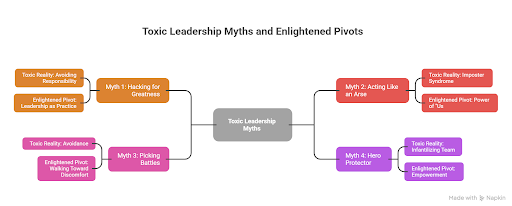
Myth 1: You Can "Hack" Your Way to Greatness
The modern business world is obsessed with the "hack." From 5-minute morning routines to "insider secrets" for building a culture, we are told that success is just one shortcut away. This is the first myth that needs to die: the belief that leadership is a series of technical tricks.
The Toxic Reality
In Terry’s philosophy, the desire for a "hack" is actually a desire to avoid Responsibility. When you look for a shortcut, you are trying to bypass the uncomfortable work of self-examination and relational repair. Hacking is the "Conventional Mind" at work—looking for the easiest way to get an external result without changing the internal person.
The Enlightened Pivot: Leadership as a Practice
Enlightened Leadership is not a destination you reach by hacking; it is a Practice. Much like a martial art or a musical instrument, it requires a daily, conscientious commitment to self-awareness and communication. There are no shortcuts to the presence required to lead a team through a crisis. You don't "hack" the Vagus Nerve; you regulate it through practice.
Myth 2: "Acting Like an Arse" is a Requirement for Success
We see it in movies, tech biographies, and across social media: the "Strong Man" archetype. This myth suggests that to be respected, you must be aggressive, uncompromising, and occasionally—to put it bluntly—an arsehole.
The Toxic Reality
Acting like an arsehole is almost always a mask for Imposter Syndrome. As the manuscript notes, bullies in leadership roles force others to feel inadequate because they secretly feel that way themselves. This behavior creates a climate of fear that destroys Psychological Safety. When your team is terrified of you, they stop giving you the honest feedback you need to survive. You end up in a "bubble of excellence" that is actually a house of cards.
The Enlightened Pivot: The Power of the "Us"
High performance is built on trust, not tyranny. Moving from the "Arse" to the "Enlightened Leader" requires you to drop the Controlling mask. When you stop using aggression to stay "on top," you create the space for a relational "Us" to form. This isn't about being "nice"; it’s about being effective enough to hear the truth from your team.
Myth 3: You Should Always "Pick Your Battles"
This is perhaps the "sneakiest" myth because it sounds so wise. We are told to conserve our energy and let the "small things" slide. While this sounds like strategic thinking, it is often a sophisticated form of Avoidance.
The Toxic Reality
"Picking your battles" is frequently a code for avoiding necessary discomfort. This myth is the preferred tool of the Pleaser and the Protector. By choosing not to address a "pebble"—a small irritation or a missed deadline—you allow it to grow into a boulder that eventually blocks the entire organization. Avoidance is a "not at my best" behavior that signals to the team that you are afraid of the truth.
The Enlightened Pivot: Walking Toward Discomfort
Enlightened Leaders don't "pick battles"; they clear pebbles. They have the "No-Nonsense" courage to turn toward difficult conversations early. By addressing issues when they are small, you build a reputation for honesty. This is the Outer Work of feedback: it requires you to get your hands dirty in the messy reality of human relationships rather than watching from the sidelines.
Myth 4: The Leader as the "Hero Protector"
Many leaders believe their primary job is to be the "Bouncer" for their team—protecting them from all stress, shielding them from the board, and carrying the full weight of the "It" (the results) on their own shoulders.
The Toxic Reality
This paternalistic model is a trap. When you act as the sole "Protector," you infantilize your team. They never learn to handle pressure, and they never develop the "Adult" response required for high performance. This is often driven by a Protecting mask; if you are the hero who saves everyone, you get to feel indispensable and superior. It is a "Me-centric" way of leading that keeps the "Us" small.
The Enlightened Pivot: Empowerment is a Two-Way Process
True leadership is about Empowerment, which Terry defines as the security to entrust others with meaningful, prestigious, and challenging tasks. An enlightened leader is secure enough to step out of the spotlight. They don't protect their team from growth; they support their team through it. They move from being the "Hero" to being the "Architect" of the team’s success.
Conclusion:
These four myths are the binary code of a Conventional Mind—a mind that is stuck in black-and-white thinking, fear of judgment, and a need for control. To move to the Post-Conventional stage of leadership, you must be willing to let these myths die.
The transition isn't easy. It requires the Inner Work of spotting your triggers and the Outer Work of delivering feedback that lands. It means moving through the Growth Cycle:
Action: Identifying when you are acting from a myth.
Review: Seeing the damage it does to the "Us."
Reflection: Understanding the fear underneath the behavior.
Learning: Choosing a new, enlightened response.
When you stop trying to hack, bully, avoid, or protect, you finally become something much more powerful: Present. And in the world of Enlightened Leadership, presence is the only thing that truly scales.
