
Pleasing, Protecting, Controlling: The 3 Limiting Attitudes Holding Leaders Back

In the world of high-stakes leadership, we often focus on what we should add—more strategy, better KPIs, or sharper public speaking. But at The Russell Partnership, we’ve found that the most significant breakthroughs happen when you identify what you need to remove.
Your leadership is run by an Operating System (OS). When that system is healthy, you act from the "Pillars" of Inspiration, Authenticity, and Performance. However, when fear enters the equation, the OS defaults to a reactive "bug." We call these the Limiting Attitudes: Pleasing, Protecting, and Controlling.
These aren't just bad habits; they are defensive "masks" we wear to hide our vulnerabilities. If you want to default to them less, you must first learn to recognize the face behind the mask.
1. The Anatomy of a Mask: Why We Hide
The concept of the "mask" is a way to visualize the aspects of ourselves we don't like to own—what therapists call the Shadow Side. Everyone moves in and out of these states, especially when the "heat" of a crisis increases.
Fear is the architect of every limiting attitude. Whether it is the fear of being wrong, being disliked, or being powerless, these masks offer a temporary sense of safety. However, that safety comes at a high cost to your team and your culture.
2. The Pleasing Attitude: The Mask of Love
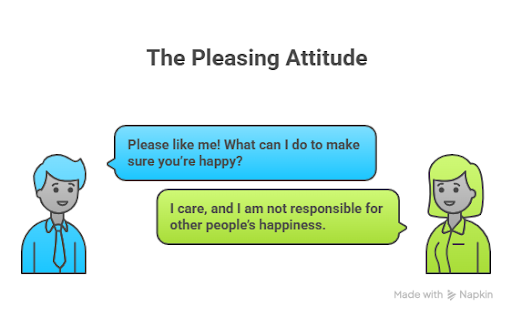
The Pleaser kneels before the audience, hands clasped, looking up with a face that asks: “Please like me! What can I do to make sure you’re happy?”
The Internal Logic: The Pleaser believes that conflict is a threat to survival. They prioritize harmony over honesty, often sidelining their own needs—and the organization's—to avoid rejection or abandonment. They get their self-worth from being "useful" or "nice."
The Cost of Pleasing:
Passive-Aggression: Disagreement is expressed indirectly, leading to a culture of gossip rather than feedback.
Resentment: By saying "yes" when they want to say "no," the pleaser eventually feels exploited and burnt out.
Lack of Innovation: Creative friction is avoided, meaning the best ideas never surface.
Case Study: Andy — From "Helping Hero" to Honest Coach
Andy was a leader who loved to be liked. He would lie awake at night worrying about his team’s personal struggles. He became a "rescuer," championing underperformers because he feared the discomfort of delivering bad news.
The breakthrough for Andy came from a simple phrase: "I care, and I am not responsible for other people’s happiness." By recognizing that his "rescuing" actually kept his team small and dependent, Andy learned to offer Radical Candor. He realized that uncomfortable feedback is a greater act of love than a polite lie.
3. The Controlling Attitude: The Mask of Aggression
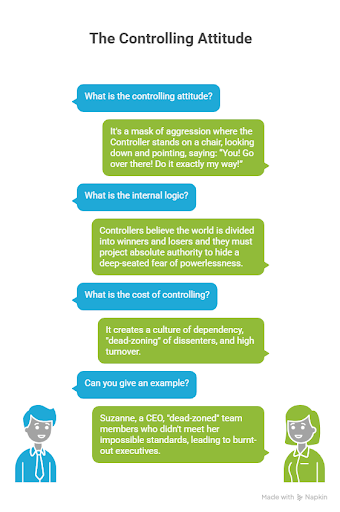
The Controller stands on a chair, looking down and pointing. Their mask says: “You! Go over there! Do it exactly my way!”
The Internal Logic: To a Controller, the world is divided into winners and losers. They believe they must project absolute authority to hide a deep-seated fear of powerlessness. Failure is intolerable, so they micromanage every detail to ensure a "perfect" result.
The Cost of Controlling:
Culture of Dependency: The team stops thinking for themselves because they know the boss will just redo the work anyway.
"Dead-Zoning": Controllers often shut out anyone who disagrees with them, leading to a "silo" where no new information can enter.
High Turnover: Talented people leave because they feel "kept small" and unvalued.
Case Study: Suzanne — Letting the "Bully Inside" Win
Suzanne was a fiercely intelligent CEO who turned businesses around with laser focus. But she was a bully. If a team member didn't meet her impossible standards, they were "dead-zoned"—she would refuse to speak to them until they quit.
Suzanne’s story is a cautionary one. Despite the financial results she achieved, the human cost was a trail of burnt-out executives. Her controlling mask was so rigid that when faced with feedback about her behavior, she "dead-zoned" her own coach. It reminds us that results at the cost of the "Us" are never sustainable.
4. The Protecting Attitude: The Mask of Logic
The Protector stands like a bouncer—arms crossed, chin out, brow furrowed. Their mask says: “I am the expert. Keep out; you’re not coming in.”
The Internal Logic: Protectors derive their self-worth from being the smartest person in the room. They are terrified of being found "wrong" or "found out." To stay safe, they withdraw from emotional exchanges and adopt a cynical, superior tone. They value logic over feeling because logic feels safe and controllable.
The Cost of Protecting:
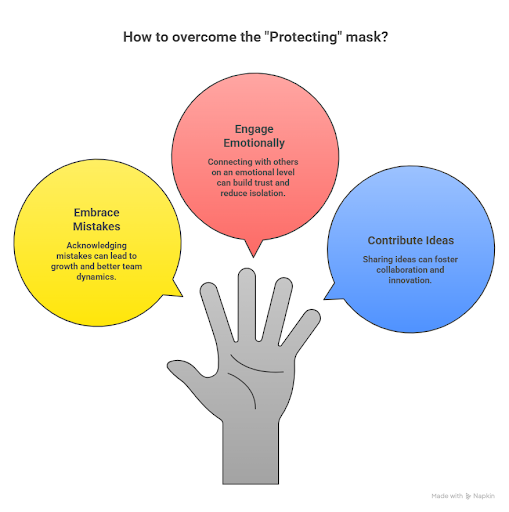
Isolation: They appear aloof and arrogant, making it impossible for others to connect with them or build trust.
Negativity Bias: They spend their time looking for flaws in other people's ideas rather than contributing their own.
Fragility: Because their ego is tied to being "right," they cannot admit a mistake, which prevents the entire organization from learning.
Case Study: Charlotte — When Expertise Becomes a Cage
Charlotte was a financial regulator who was "as quiet as a mouse" in meetings. Her silence wasn't humility; it was a sophisticated "Protecting" mask. She was terrified that if she spoke up and made a mistake, she would be seen as an "idiot."
By laughing at her "mess-ups" in coaching sessions, Charlotte began to "thaw." As she let go of the need to be the perfect expert, she ironically became more valued. When she stopped protecting her ego, her team felt she was finally "in the room" with them.
5. Breaking the Cycle: From Reactive to Adult
Identifying your mask is the first step in the Growth Cycle. When you feel a "hangover" of shame, fury, or numbness, your OS has likely been hijacked.
Awareness: Name the mask. Are you currently trying to Please, Protect, or Control?
Regulation: Breathe. Use your Vagus Nerve to calm the "Limbic Hijack."
Reflection: What was the underlying fear? What is the healthy "Adult" response?
Conclusion: Take Off the Mask
Enlightened Leadership isn't about being perfect; it’s about being Authentic. Every limiting attitude has a "Green" side—moderate pleasing is loyalty; moderate control is high standards; moderate protection is logical clarity.
The goal isn't to kill these parts of yourself, but to step out from behind the mask so you can lead with your full, unfiltered self. Stop performing leadership and start practicing it.
