
Inner Work vs Outer Work: The Two Sides of Great Leadership

The traditional approach to leadership development is fundamentally flawed. We treat it like a technical patch—bolt on a new skill, attend a weekend seminar, or memorize a feedback script—and wonder why nothing actually changes. This fails because it ignores the "Operating System" (OS) driving every interaction you have.
At The Russell Partnership, we view leadership not as a list of traits, but as a rigorous, daily practice. It is the constant calibration between the "Inner Work" of self-regulation and the "Outer Work" of team execution. One cannot function without the other.
Enlightened Leadership is about closing the "Relationship Gap." When you neglect your internal state, your external actions become "hollow"—the team senses the incongruence between what you say and who you are being. To drive the "It" (the results), you must first align the "Me" (the leader) with the "Us" (the team).
The Inner Work — Debugging the Leadership OS
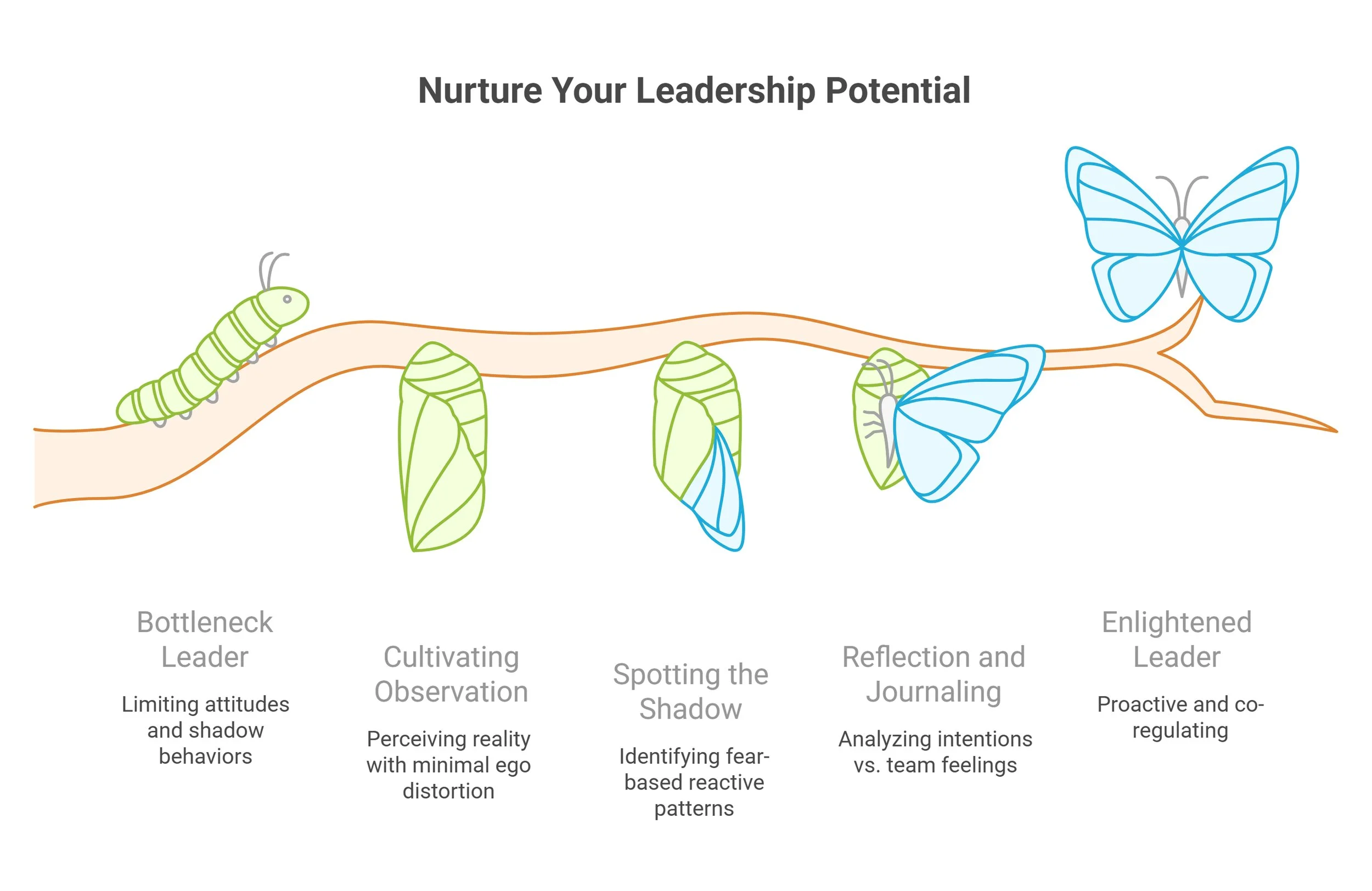
Inner Work is the process of assessment, reflection, and radical self-awareness. It is about looking "under the hood" to identify the limiting attitudes and shadow behaviors that cause a leader to become a bottleneck.
1. Cultivating an Observing Mind
The foundation of inner work is the capacity for self-observation—perceiving reality with minimal distortion from the ego. This is the ability to stand back from your thoughts and watch them without immediate judgment.
This requires physiological regulation. The Vagus Nerve plays a critical role in how we lead. When your nervous system is calm, you signal "safety" to the entire room.
A regulated leader co-regulates a room; a dysregulated leader amplifies stress. By mastering the art of observation, you learn to catch the "limbic hijack" before it dictates your response to a challenging team member.
2. Spotting the "Shadow Side" (Fear-Based Code)
Inner work involves getting to know your "Shadow Side"—the reactive patterns of Pleasing, Protecting, or Controlling that emerge whenever the "heat" of the environment increases.
These "bugs" in the OS are almost always driven by underlying fears: the fear of being wrong, the fear of being disliked, or the fear of losing your status as the "expert" in the room.
By naming these emotions in real-time, you dampen the brain's threat response. This internal "debugging" allows you to move from a reactive state of survival to a proactive state of enlightened leadership.
3. The Science of Reflection and Journaling
Journaling is often dismissed as "fluff," but in the OS Model, it is essential maintenance. The manuscript suggests that just seven minutes of structured reflection can fundamentally shift a leader’s trajectory.
Reflection allows you to look at the "Relationship Gap"—the distance between what you intended to happen in a meeting and what the team actually felt. Without this inner work, the gap remains invisible to you.
The Outer Work — Tried and Tested Playbooks
Outer Work consists of the visible practices and behaviors that shape a team’s experience. While Inner Work fixes the "software," Outer Work is the "hardware" through which leadership is delivered.
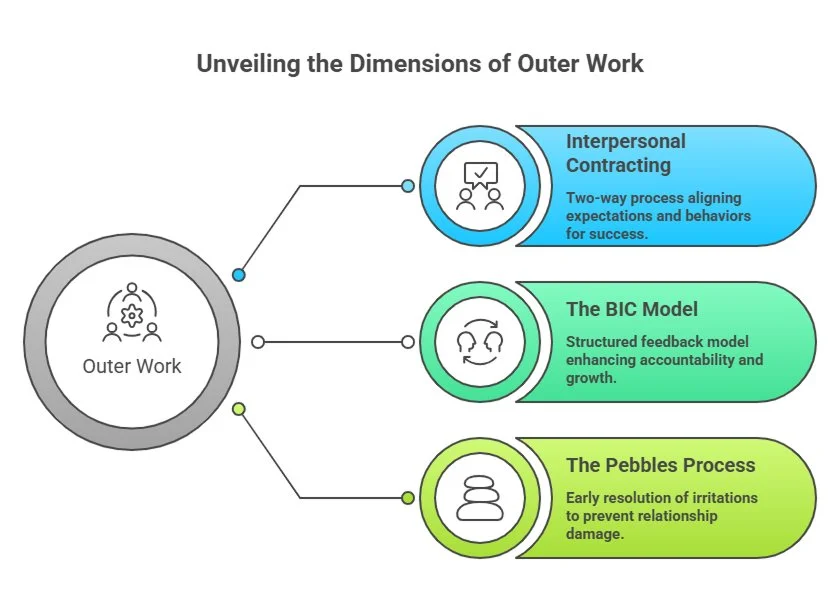
1. Interpersonal Contracting
Great leaders do not just set goals; they "contract" with their teams. This is a two-way process where both parties agree on expectations, behaviors, and what they need from each other to succeed.
If expectations are not explicitly stated, they are unstated. The manuscript warns that unstated expectations are the primary cause of the "Spiral of Damaged Relationships," where silent resentment builds into open conflict.
Outer work involves having the courage to have these contracting conversations early. It is the practice of ensuring that the "Us" is aligned before you ever try to execute the "It."
2. The BIC Model: Feedback that Lands
To enhance accountability, leaders must deliver feedback that is both supportive and challenging. Many leaders avoid this outer work because they fear the discomfort of the "Relationship Gap."
The BIC Model (Behavior, Impact, Consequence) provides a structured way to deliver data without triggering a defensive response. You describe the behavior, explain its impact on the team, and outline the long-term consequences.
When you pair this outer skill with the inner work of self-regulation, your feedback becomes a gift rather than a weapon. It helps the team grow because they feel your "Natural Presence" rather than your "Shadow Side."
3. The Pebbles Process
Relationships are often damaged by small irritations—"grains of sand" that rub until they feel like "pebbles" in a shoe. Outer work is the willingness to walk toward this discomfort rather than ignoring it.
The Pebbles Process is a safe way to verbalize these frustrations before they turn into explosive anger. It requires "Level 4" Deep Listening—listening with an open mind and heart to truly learn.
By addressing the "pebbles" early, you prevent the erosion of trust. This is a high-level outer work skill that requires the leader to step off the "hero pedestal" and engage as a human being.
Bridging the Gap — The Growth Cycle
The bridge between Inner and Outer work is the Growth Cycle. This model allows leaders to turn every experience into a learning opportunity.
The Components of the Cycle:
Action & Experience: Stepping out of your comfort zone to try new behaviors in the "Outer Work" world.
Review & Reflection: The "Inner Work" of looking back at what happened with total honesty and self-compassion.
Learning & Planning: Synthesizing those insights into a new plan of action for the next "Outer Work" challenge.
The most important part of this cycle is the bottom-right corner: Review, Reflection, and Learning. Without these, you are simply "busy," repeating the same mistakes over and over again without ever upgrading your system.
The 12-Step Inner Work Debugging Checklist
To help you practice this duality daily, we have extracted an audit checklist. This checklist helps you determine if your "Inner Work" is currently supporting your "Outer Work" results.
Internal Code Audit (Me)
Am I currently in a state of physiological regulation, or am I "triggered"?
What is the primary emotion I am feeling right now (Fear, Anger, Joy)?
Am I trying to "Please, Protect, or Control" in this specific interaction?
What is the "self-story" I am telling myself about this situation?
Relational Audit (Us)
Have I explicitly contracted with this person regarding our expectations?
Am I "holding the pen" too tightly because of a perfectionist bug?
Is there a "pebble" in this relationship that I have been avoiding?
Am I listening to hear, or am I listening only to respond?
Performance Audit (It)
Is the team’s current struggle a result of my own "Shadow Side"?
Have I provided enough support to match the level of challenge I am giving?
Are we using the Growth Cycle to learn from our recent setbacks?
Is our "It" (the goal) suffering because our "Us" (the team) is fractured?
The Cost of Neglect — The Shadow Side in Action
When a leader focuses solely on Outer Work (the KPIs, the strategy) while neglecting Inner Work, they inevitably become what we call an "Arse at Work."
They might achieve short-term results, but they do so at the cost of the team's psychological safety. Their "Shadow Side" takes over, creating a culture of fear where people are afraid to innovate or speak the truth.
Conversely, a leader who only does Inner Work but fails at the Outer Work (the feedback, the accountability) becomes a "Pleaser." They create a "nice" environment where nothing ever actually gets done.
Beyond the Hero Mythology
The "Hero Leader" believes they must have all the answers. This is an "Outer Work" mask that hides a lack of "Inner Work" confidence. Enlightened Leadership requires the vulnerability to say, "I don't know."
By balancing the two, you move from being a "boss" who manages tasks to a leader who cultivates potential. You stop being the bottleneck and start being the catalyst.
Evolve Beyond the Hero Mythology
Enlightened Leadership is not a destination; it is a daily practice. If you are ready to move beyond the myths of "strength and stoicism" and build a culture of genuine empowerment, the work starts with you.
Commit to the Practice: Explore the full Enlightened Leadership methodology and start bridging your relationship gap today.
Join the Movement: We are currently finalizing the definitive guide to Terry's OS Model. Sign up for the waitlist to receive the full "No-Arse" leadership audit and early access to the book launch.
