
The Leadership Operating System: A New Model for Self-Aware Leadership
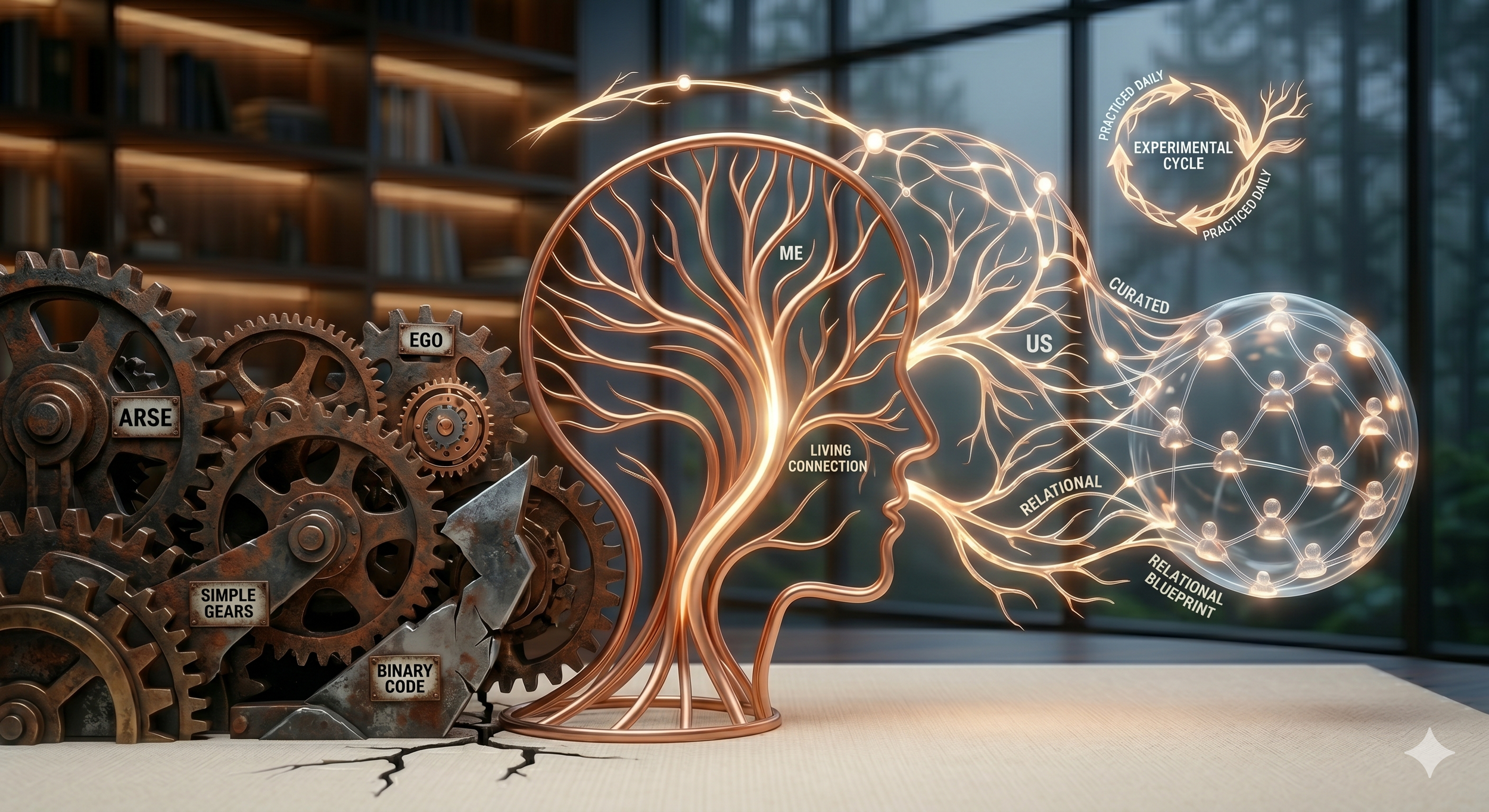
Most leadership development programs fail because they try to install new "apps" onto a system that is fundamentally broken. If your internal leadership operating system model is outdated, no amount of new skills will make you effective.
At The Russell Partnership, we believe leadership isn't a static trait you are born with; it is a rigorous, daily practice. It is a relational dynamic that exists only in the space between people, requiring a constant "Me-Us-It" alignment.
To lead effectively in the modern world, you must be willing to look under the hood at the code running your interactions. This guide explores the OS Model—a framework designed to help you move from the hero mythology to a collective reality.
Defining the Leadership Operating System Model
In technical terms, an Operating System (OS) is the software that supports a computer’s basic functions and background processes. In leadership terms, your OS is the internal landscape of attitudes, beliefs, and reactive patterns that dictate your presence.
The Relational Reality
Leadership does not happen in a vacuum; a "leader" exists only in relationship to a team of people. If you are on an island alone, you aren't leading anyone; you are simply taking a quiet, solitary walk.
Therefore, any effective model of leadership must be inherently relational rather than focused purely on the individual's traits. The OS Model assesses how a leader operates in relation to others, mapping strengths and struggles as they show up.
The "Me-Us-It" Philosophy
To understand the OS Model, you must understand the hierarchy of organizational health that Terry utilizes in his coaching. First is "Me," the leader’s internal state; second is "Us," the team’s trust; and third is "It," the goals.
The "No-Nonsense" truth is simple: Without US, there is no IT, and without ME, there is no US. If you don't look deeply at yourself (Me), you cannot build a functional team (Us) to deliver results.

The Three Core Pillars of the OS Model
The OS Model isn't about personality types or "styles" that put you in a restrictive, unchangeable box. It is a snapshot of behaviors, identifying both your Natural Strengths and the unhelpful "Shadow Side" of your leadership.
Pillar 1: Inspiration
Inspiration is the ability to shift focus from the individual to the organization's collective vision. In an outdated OS, a leader tries to be "exceptional" to impress others, but in a modern OS, the leader is simply present.
Pillar 2: Authenticity
There is almost always a gap between how a leader thinks they are behaving and how the team actually experiences them. Authenticity is the practice of "plugging this gap" by cutting through your self-story to see your actual impact.
Pillar 3: Performance
Performance is not a separate, cold goal; it is the natural byproduct of a healthy, functioning relational system. When the OS is clear of "bugs" like fear or the need for control, the organization's performance accelerates naturally.
Deep Dive into the "Shadow Side"
Every leader has a shadow side—unhelpful behaviors that trigger automatically when the "heat" of the environment is turned up. These are the bugs in your leadership operating system model that cause friction and slow down growth.
The Perfectionist Bug
As seen in many high-stakes industries, the need for technical excellence often morphs into a destructive need for total control. Leaders become "controllers" rather than "empowerers," which eventually kills the initiative and creativity of the entire team.
The Bottleneck Effect
When your OS is set to "Perfectionist," you become the bottleneck, slowing down every project that requires your final approval. Projects that should take weeks can take years because the leader is too afraid to let go of the pen.
The Ego Virus
The ego is the most common virus in the leadership OS, manifesting as a desperate need to always be the expert. All of these settings focus on "Me" and ignore the "Us," creating a culture of disempowerment and silence.
Industry Perspective — How Leadership Teams Evolve
To see this model in action, we can look at external case studies from industry experts and master facilitators. One such study involved a 12-month transformation of a critical advisory function struggling with technical perfectionism.
The Shift in Code
The transformation required three significant shifts in their leadership operating system model to unlock their team's potential:
From Perfectionist to Experimentalist: They moved from "100% right" to "80% right now is better than 100% later."
From Controller to Empowerer: They stopped "holding the pen" and shifted their identity to enabling the team's talent.
From Risk-Aversion to Value-Creation: They stopped asking "What might go wrong?" and started asking "How do we add value?"
The Result of the Upgrade
The team developed a bias for "purposeful action" rather than just staying busy with low-value, high-control tasks. By shifting the internal question to "What can we learn?", they accelerated delivery and re-engaged their previously disempowered staff.
The "12-Step Debugging Checklist" for Leaders
To maintain a high-performance leadership operating system model, you must perform regular system audits. Use this 12-step checklist to identify where your "Me" is currently obstructing the "Us" and the "It."
The "Me" Audit (Internal Code)
Am I acknowledging that I am a "work in progress" today?
Can I identify one limiting attitude that influenced my last decision?
Am I acting out of a need to be liked or a need to be right?
How much of my daily schedule is driven by ego-maintenance?
The "Us" Audit (Relational Connectivity)
Is there a gap between my intended message and the team's reaction?
Am I "holding the pen" on tasks that my team is capable of finishing?
When was the last time I sat "off the pedestal" with my staff?
Am I creating enough "psychological safety" for people to disagree with me?
The "It" Audit (Performance Output)
Is my team’s output slow because of my need for perfection?
Am I focusing on "being busy" rather than "creating value"?
Is the organization’s goal clear to everyone, or just to me?
Am I rewarding "experimentalism" or punishing minor mistakes?
Navigating the Relationship Gap
The "Relationship Gap" is the most expensive hidden cost in your business. It represents the psychological distance between what you say and what your team hears, or what you intend and what you achieve.
The Cost of Incongruence
When a leader says they value "innovation" but punishes small mistakes, they are running an incongruent OS. This bug creates confusion, as the team stops listening to your words and begins over-analyzing your micro-reactions for safety.
Detecting the Signal
To close this gap, a leader must develop a high degree of "Presence." This means being aware of your emotional state in real-time, especially during high-stress interactions where your shadow side is most likely to take over.
Real-Time Debugging
When you notice a "Me" bug appearing—like a sudden urge to snap at a colleague—stop and acknowledge it. This pause is where the upgrade happens, allowing you to choose a relational response over a reactive, ego-driven defense.
Why the OS Model is Essential for Growth
As organizations scale, the "Hero Leader" becomes the greatest liability to the company's long-term survival. The individual excellence that built the company eventually becomes the bottleneck that prevents the team from growing and evolving.
Sustainable Change Requires "Heat"
Change doesn't happen when things are comfortable; it requires "heat" from market pressures or internal frustrations. The OS Model uses this heat as a catalyst to disrupt the status quo and force a necessary system upgrade.
The Importance of Collective Support
Transformation is never a solo journey; you need a "work family" of coaches and tools to succeed. To successfully upgrade your leadership operating system model, you must be supported by those who value growth over comfort.
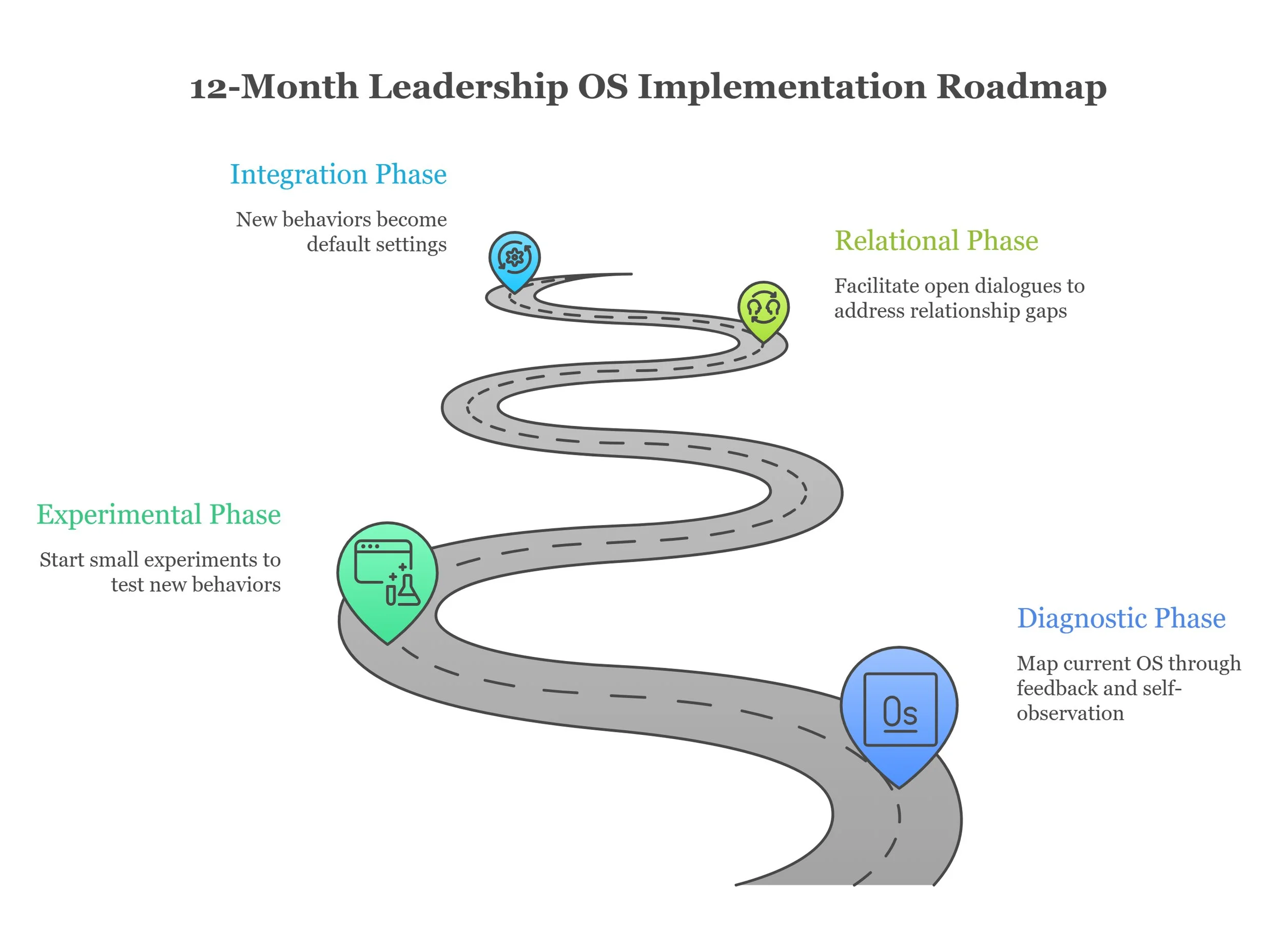
Implementing the OS Model — A 12-Month Roadmap
True leadership transformation takes time because you are rewiring years of ingrained behavioral patterns. A structured approach ensures that the "Me" work leads to measurable improvements in the "Us" and the "It."
Months 1–3: The Diagnostic Phase
The first quarter is about mapping your current OS through feedback and self-observation. You must identify your primary shadow behaviors and acknowledge the "pedestal" moments where you disconnected from your team.
Months 4–6: The Experimental Phase
This is where you begin "Learning over Languishing." Start small experiments, such as delegating a task you would normally micromanage, and document the relational impact it has on the team's performance.
Months 7–9: The Relational Phase
Focus heavily on the "Us" by facilitating open dialogues about the Relationship Gap. Encourage your team to call out "incongruent" behaviors, effectively turning the team into a support network for your ongoing OS upgrade.
Months 10–12: The Integration Phase
By the final quarter, the new behaviors should start becoming your default setting. You will notice that "Inspiration, Authenticity, and Performance" are no longer goals you chase, but natural outcomes of your presence.
The Future of Self-Aware Leadership
The OS Model is not static; it offers a snapshot of how you are showing up at this exact moment in time. Because your environment changes, your OS will change, meaning you must revisit the model regularly to stay effective.
The Final No-Nonsense Truth
If you want to create value for those you lead, you must be willing to look deeply at the "Me." You have to cut through your own self-story to see the behaviors that are truly shaping your team’s experience.
Beyond Management
Management is about maintaining the system; leadership is about evolving it. By mastering your leadership operating system model, you move from being a "boss" to being a catalyst for collective human potential.
Master Your Leadership Practice
Ready to stop being the bottleneck? The journey to high-performance leadership begins with a deep dive into your own Operating System.
Explore our core philosophy on theRussell Partnership and learn how we help leaders close the gap between intent and impact.
Join the Movement
We are currently developing a definitive guide to upgrading your Leadership OS. Join our waitlist to be the first to receive exclusive tools, the "No-Arse" leadership audit, and updates on the upcoming launch.
Practice Of Enlightened Leadership — The Russell Partnership
