
Spotting Your Triggers: Why Black and White Thinking Derails Leaders

In the high-pressure arena of modern leadership, the stakes often feel unprecedented. Leaders today navigate a relentless landscape of technological change, economic turbulence, and hyper-visibility. In this environment, the temptation to become a reactive "pinball," bouncing from crisis to crisis, is immense. When this happens, leaders frequently fall into a dangerous cognitive trap: Black and White Thinking.
Understanding how to spot your triggers and escape binary perspectives is a foundational element of the Inner Work required for enlightened leadership. Without this self-awareness, leaders remain "not at their best," governed by fear-based reactions rather than conscious, purpose-driven responses.
What Happens When You’re Triggered?
The term "triggered" is often misunderstood, but for a leader, it describes a specific physiological and psychological event. When you are triggered, it is as if "ghosts" from your past—previous fears, limiting beliefs, or old behavioral patterns—take over your vision. It’s like holding a mobile phone directly in front of your face; the screen is so close that you can no longer see the reality of what is actually happening in the room.
Physiologically, your body broadcasts danger signals that override rational thought. You might experience:
A fuzzy or hazy feeling in your head.
Tightness in the chest or a thumping heart.
A "fight, flight, or freeze" instinct.
In this dysregulated state, the higher-level cognitive functions required for strategic leadership are simply unavailable. You lose nuance, and your perspective distorts.
The Three Defensive Styles of Binary Thinking
Black and white thinking is not a one-size-fits-all response. In our Leadership Operating System (OS) model, these reactive patterns typically align with three defensive "masks" or limiting attitudes: Protecting, Controlling, and Pleasing.
1. The Protecting Style: Fear of Incompetence
For leaders who default to the Protecting mask, the primary trigger is often an interaction that makes them feel stupid, exposed, or "not an expert". An unexpected technical question in a meeting can feel like a direct ambush.
The Black and White Thought: "People are intentionally trying to undermine me and set me up to fail".
The Result: Nuance disappears, curiosity shuts down, and the leader withdraws or becomes isolated, further eroding team trust and collaboration.
2. The Controlling Style: Fear of Powerlessness
Controlling types are triggered when they feel a loss of order or when universal rules—like fairness or equity—are ignored.
The Black and White Thought: "I am right, and anyone who disagrees is a narcissist or an arsehole".
The Result: The leader becomes increasingly domineering and intolerant. They lose the capacity to imagine another person's perspective, believing their view is the only "correct" one.
3. The Pleasing Style: Fear of Rejection
The Pleasing leader is triggered by feelings of being unrewarded, taken for granted, or exploited.
The Black and White Thought: "Others are being cruel or indecent, and I am a victim of their selfishness".
The Result: They fall into a "freeze" response, losing motivation and feeling stuck. Alternatively, they may "fawn," frantically over-pleasing to regain approval, which often feels manipulative and leads to further burnout.
How Triggers Derail the "Outer Work" of the Team
The "Inner Work" of managing triggers is not a solo pursuit; it defines the culture of the entire team. When a leader is triggered, they "bring the weather," amplifying stress for everyone else.
Consider these common scenarios where binary thinking destroys team performance:
The Adversarial Strategy Meeting: A legitimate question about a project roadmap is heard as a critique of competence. The room polarizes into "attackers" and "defenders," egos are protected, and the final decision is rushed and narrow.
The Loyalty Test Feedback: During a feedback session, leaders perceive concerns as accusations. Instead of exploring patterns, they debate intent, viewing everything through the lens of "you’re either for us or against us".
The Crisis Shutdown: Under intense pressure, a team defaults to certainty to manage fear. Ambiguity feels intolerable, so dissent is shut down in favor of "decisive action" that may be headed in the wrong direction.
Breaking the Cycle: Moving Toward the "Grey"
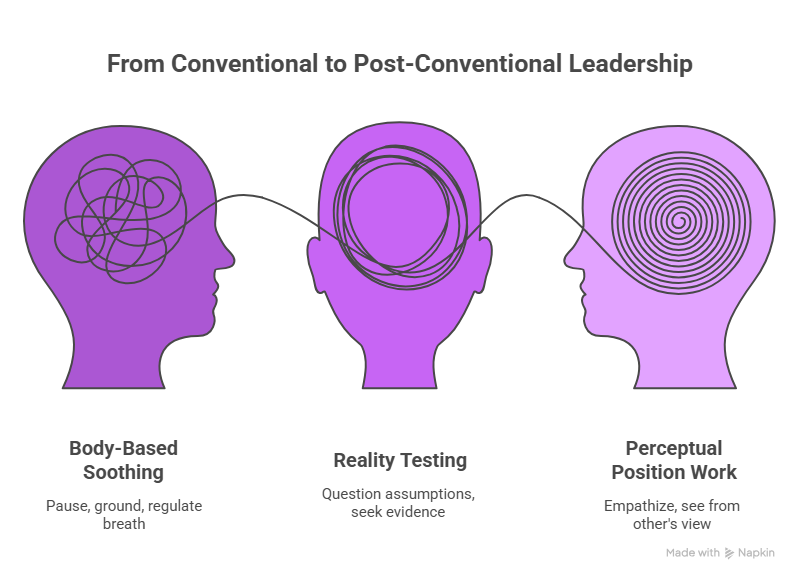
Enlightened leadership requires moving from a "conventional mind"—one defined by black and white terms and a need to be right—to a "post-conventional mind" that embraces complexity.
Step 1: Body-Based Soothing
You cannot "think" your way out of a physiological hijack. When you feel the physical signs of being triggered:
Pause: Permit yourself to stop before reacting.
Ground yourself: Notice your feet on the floor.
Regulate your breath: Ensure you are breathing freely and not shallowly.
Step 2: Reality Testing
Once calm, engage in "Inner Work" to dismantle the binary narrative. Ask yourself:
"What else might be possible?"
"What evidence contradicts my assumption that I am being attacked or ignored?"
"Am I post-rationalizing a triggered response?" (e.g., Telling yourself "shouting was the only way to get through to them" ).
Step 3: Perceptual Position Work
This is the "Outer Work" of empathy. Literally imagine yourself in the other person's shoes. Ask:
"What might they have seen or experienced during that interaction?"
"How might my reactive behavior have impacted their psychological safety?"
Conclusion: Leadership as a Practice
Spotting your triggers and expanding your capacity for "the grey" is not a task you master once; it is the work of a lifetime. By committing to this level of self-awareness, you transition from a reactive leader who amplifies stress to an enlightened leader who provides composure and presence.
True leadership doesn't reside in having all the answers, but in the willingness to stop being governed by fear and instead lead with curiosity, listening, and adaptability. The next time you feel the pull toward a "simple" black and white story, let it be your signal to slow down, breathe, and ask what else might be possible.
