
What Is Enlightened Leadership? The Complete Guide to the Practice

At The Russell Partnership, our perspective has been forged in the trenches. Over forty years, we have sat in the rooms where the most critical global decisions are made—from the high-velocity environments of Tech startups to the complex, multi-layered boardrooms of the FTSE 100.
We have observed a recurring, systemic failure: most leadership development is fundamentally incomplete.
The industry is obsessed with "Horizontal Development"—the act of adding more skills, more frameworks, and more KPIs to a leader’s repertoire. While useful, this approach ignores the most critical component: the Operating System of the leader themselves. Information is not transformation. At the Partnership, we don’t offer tips; we offer a Vertical Upgrade.
The Crisis of the "Broken Hard Drive"
In the high-stakes sectors we serve—Pharma, Tech, and FMCG—the pace of change is non-negotiable. Organizations are currently navigating AI integration, shifting cultural expectations, and unprecedented volatility.
The standard corporate response is usually a "leadership retreat" focused on surface-level competencies. We view this as adding high-performance apps to a smartphone with a cracked screen and a dying battery. The apps aren't the problem; the Operating System (OS) is.
Enlightened Leadership is the practice of upgrading the "self" that is doing the leading. It is the shift from a reactive state—defined by self-protection and control—to a creative state, where leaders perceive the world as it actually is, not through the lens of their internal biases.
Defining Enlightened Leadership
At The Russell Partnership, we define Enlightened Leadership as the deliberate practice of paying attention.
It is not an innate trait or a "visionary genius" reserved for the few. It is a methodology of listening—to what is happening within the leader, and what is occurring between the leader and their organization. We move leaders away from the "Hero" myth toward a model of The Observing Mind.
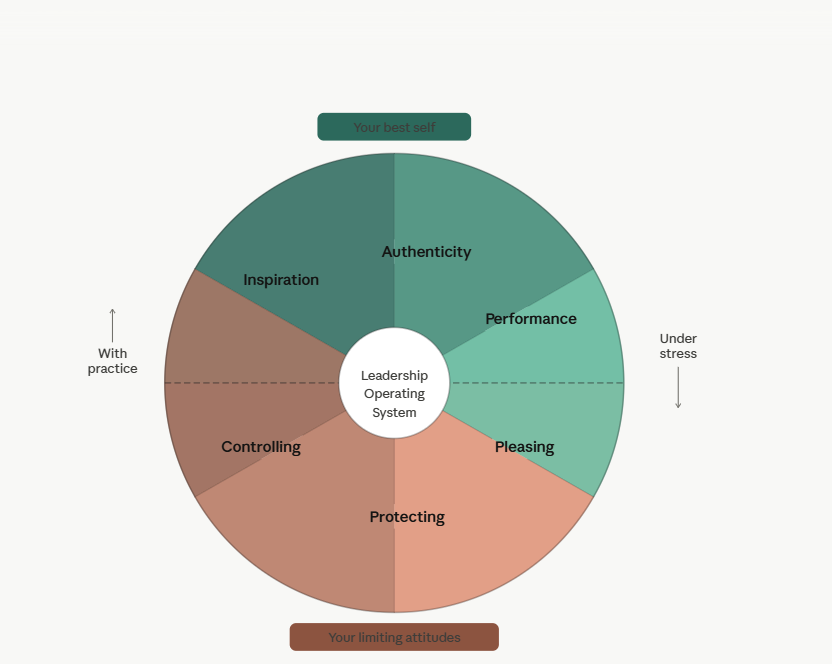
The Leadership Operating System (OS)
Our proprietary OS model is divided into two distinct halves:
The Upper Half (The 3 Pillars): Inspiration, Authenticity, and Performance.
The Lower Half (Limiting Attitudes): Pleasing, Protecting, and Controlling.
Most consultancies focus exclusively on the top half. We believe that is a mistake. You cannot sustain high performance without addressing the "Shadow Side" that sabotages it.
The Three Pillars: The Architecture of Impact
When a leader’s OS is upgraded, three distinct "outputs" emerge. At the Partnership, we treat these not as goals, but as the natural result of a healthy system.
1. Inspiration: The Management of Energy
We start from a foundational belief: Nobody turns up to work to do a bad job. People desire to be inspired, yet many leaders inadvertently manage the energy out of the room.
The Practice: Moving beyond "carrots and sticks" to connect daily operations to a larger mission. An enlightened leader manages the energy of the team by painting a future that people actually want to co-create.
2. Authenticity: The Death of the Corporate Mask
Authenticity is often treated as a soft HR buzzword. At the Partnership, we see it as a gritty, high-performance necessity. When a leader stops "performing" leadership and starts practicing it, they stop wasting energy on image management.
The Practice: Grounded consistency. Authentic leaders don't wear masks. This transparency builds "Trust Equity," allowing the organization to move faster and with less friction.
3. Performance: The Standard of Excellence
Enlightened Leadership is not "soft." It is designed to deliver. However, we redefine performance as excellence achieved through Clarity and Accountability, rather than Pressure and Fear.
The Practice: Modelling the standard. High performance is a byproduct of a leader who is decisive in ambiguity and reliable under fire, without the paralyzing weight of perfectionism.
The Shadow Side: Navigating Limiting Attitudes
This is the "Raw Insight" that defines our work. Your leadership—and your organization’s culture—is currently being held back by "Limiting Attitudes." These are defensive maneuvers developed by the ego that operate in the background of your OS.
The Pleaser
This leader avoids conflict to maintain approval. In high-growth Tech firms, this often results in a "culture of nice" that masks deep-seated inefficiencies and allows toxic behaviors to fester.
The Protector
The leader who uses intellect or distance as a shield. They are often "right" but remain isolated. They protect their ego at the expense of the mission, stifling the psychological safety required for innovation.
The Controller
The leader who believes that results are only achieved through direct force. This attitude values output over people, eventually leading to high turnover and systemic burnout.
Preparing the Ground: The Inner Work
A leader cannot simply "decide" to be enlightened. The Partnership guides leaders through Preparing the Ground, which involves cultivating an Observing Mind. Most leaders are "merged" with their reactive thoughts. If they feel threatened by a competitor, they act on that threat immediately. Our methodology creates a gap between the Trigger and the Response. In that gap lies the freedom to lead effectively.
Case Study: The Agile Failure
We recently observed a major organization attempt an "Agile" transformation. Despite spending millions on software and training, the initiative failed. The reason? The leadership had not "prepared the ground." They were trying to run an Agile "app" on a Controlling "OS." Our role was to facilitate the vertical upgrade necessary for the system to actually function.
The Anatomy of a Leader: Navigating Triggers
Leaders are biological systems. When a board member questions your strategy or a project fails, your body enters a "threat" state. Your IQ drops, and your OS reverts to its most primitive version.
The Russell Partnership trains leaders to navigate these triggers in real-time by:
Noticing the Physical Sensation: Recognizing the biological "hijack."
Naming the Emotion: Identifying the underlying fear (e.g., "I am afraid of appearing incompetent").
Choosing the Pillar: Intentionally shifting the response back to Inspiration, Authenticity, or Performance.
The Outer Work: Excellence in Action
Once the internal upgrade is underway, the "Outer Work" of leadership becomes a streamlined process.
Difficult Conversations: We reframe these as acts of Compassionate Accountability. Withholding feedback is not "kind"—it is an obstacle to growth.
Genuine Empowerment: This is not mere delegation. It is the architectural act of building a system where teams have the clarity, resources, and permission to innovate and learn.
Why "The Practice" Never Ends
We titled our methodology The Practice of Enlightened Leadership for a reason. There is no finish line.
In a world that demands perfection, we advocate for Continuous Practice. Even the most seasoned leaders get triggered. The difference in an Enlightened OS is the ability to catch the reaction and reset the system in minutes rather than days.
The "toxic" status quo of modern management is built on myths of invincibility. We are here to dismantle those myths and replace them with a sustainable, high-performance reality.
Conclusion:
Sustainable results are possible. High-performing, resilient, and authentic cultures are within reach. But they require a different type of leadership.
The Russell Partnership doesn't offer "off-the-shelf" training. We offer a deep dive into the raw reality of your organization. We help you upgrade your OS so you can finally achieve the innovation and trust your mission demands.
Are you ready to architect an Enlightened Culture?
