


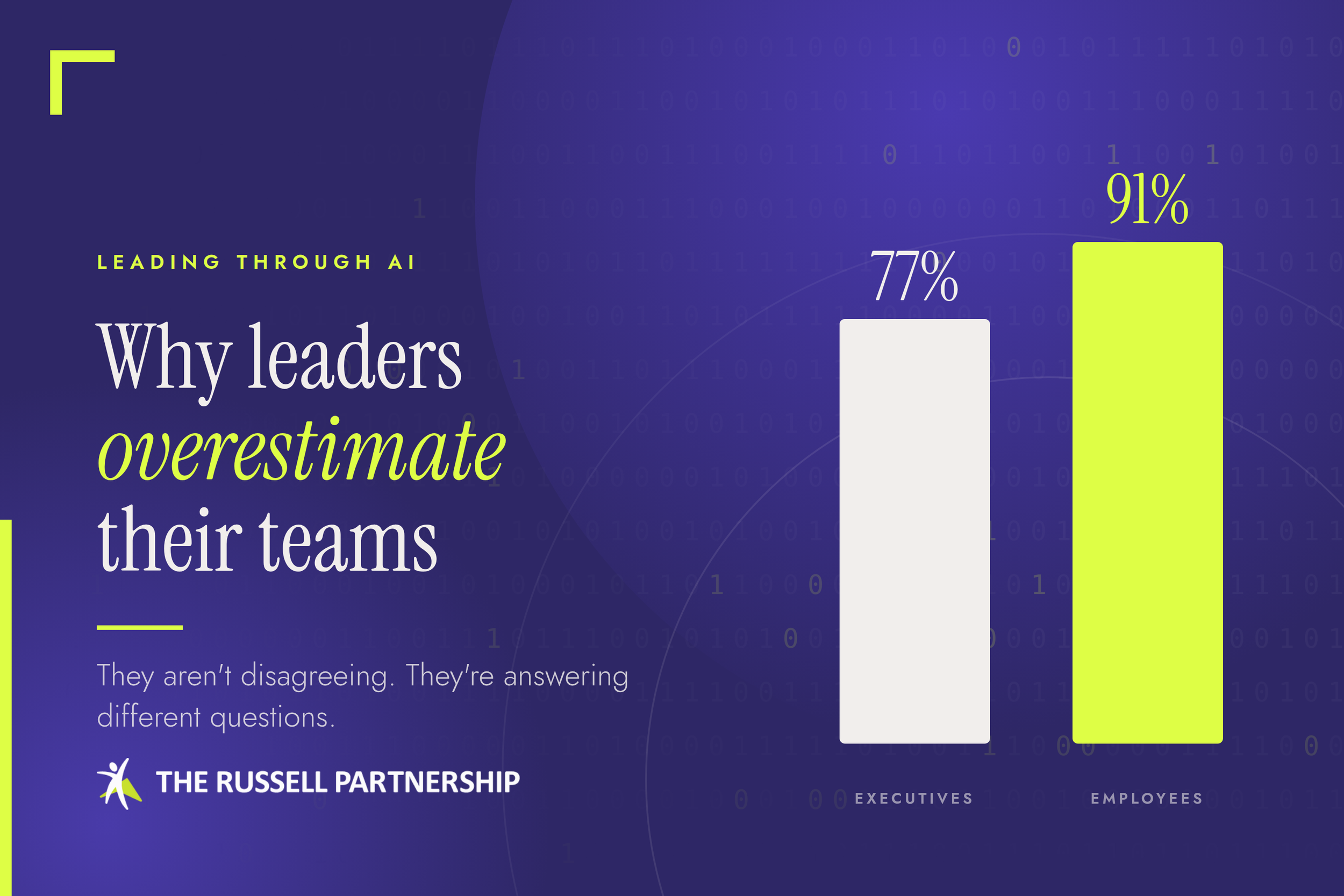
Ask an executive team whether their managers are ready to guide people through AI, and about three quarters will say yes. Ask the people who report to those managers, and nine in ten will say no.
Those are real numbers. Acorn surveyed 1,224 professionals across the UK, US, Canada and Australia, at organisations of a thousand people or more, from the C-suite down to individual contributors. 77% of executives believe their managers are prepared to guide AI skills development. 91% of employees say their managers lack that preparation.
A fourteen point gap would be a rounding error. This is not that. These two groups are describing the same set of people and arriving at almost opposite conclusions.
The interesting question is not who is right. It is why a gap that size is even possible.
They are not disagreeing. They are answering different questions.
When an executive is asked whether managers are prepared, they answer a question about the system. Have we run the training. Is it in the competency framework. Did the completion rates come back high. Do we have a capability plan with the right boxes ticked.
By that measure, most large organisations genuinely are prepared. The programme exists. People went on it. The slide says so.
When an employee is asked the same question, they answer a question about one person on one Tuesday. Did my manager know what to do when I showed them something I had built with AI and asked whether it was good enough to send. Did they have a view, or did they say use your judgement and change the subject.
Both answers are honest. They are just measuring different things, and only one of them is measuring behaviour.
This is the same split we wrote about in what AI can't do. Capability on paper and capability in the room have never been the same thing, and AI has pulled them further apart, because the paper version is now very easy to produce.
Why the executive number is the dangerous one
It would be easy to read this as leaders being out of touch, and leave it there. That is not quite it, and it is not useful.
The problem is what gets bought on the back of the executive number. If the board believes managers are 77% ready, the investment goes somewhere else. More tools, more licences, another platform, because the people side is apparently handled.
Meanwhile the 91% is the number that actually governs whether any of it works. Microsoft's 2026 Work Trend Index puts roughly two thirds of AI impact down to organisational factors, culture, manager support and talent practices, against about a third for individual skill and mindset. The manager is not a nice-to-have in that equation. They are most of it.
So the overestimate is not embarrassing. It is expensive. It redirects money away from the only lever that moves the outcome.
What a manager actually has to do for someone to answer yes
It is worth being specific about what the employees are actually missing, because it is smaller than it sounds.
They are not asking their manager to understand the technology. Almost nobody expects that, and the manager is rarely the most fluent person in the team anyway.
What they want is a view. Somebody who will look at a piece of work and say this is good enough to send, or this is not, and explain which. Somebody who will say out loud what it is acceptable to use AI for here and what it is not, so people are not guessing. Somebody who notices when a quiet person has quietly stopped asking anybody anything.
All of that is judgement rather than knowledge. It is the same skill set that makes somebody good at giving feedback that actually lands, and it is the thing nobody has given these managers permission or practice to do.
Terry Russell's line on this is that culture gets built through thousands of small interactions, and that in each one leaders teach people three things: what matters here, what gets rewarded here, and what gets tolerated here. A manager who has no view on AI is still teaching all three. They are teaching that nobody knows, that it does not matter much, and that you are on your own.
How to find out which number is true in your organisation
You do not need a survey for this. You need three questions, and you can ask them this week.
Ask a few people below manager level what they did the last time they were unsure whether something they had produced with AI was good enough. Who did they ask. If the answer is nobody, or a colleague at the same level, you have your number.
Ask a few managers what they would say if someone brought them that question. Listen for whether they have an actual position or whether they reach for it depends.
And ask what has changed in the last six months about how work gets reviewed. If the answer is nothing, then nothing has changed, whatever the training completion rate says.
That is the same test we would apply to any capability claim. A value is a word until somebody can point at a behaviour, which is why turning values into behaviours is the first move in almost every piece of this work.
Common questions
Why do executives overestimate their managers' AI readiness? Because they are answering a question about the system rather than about behaviour. Training exists, completion rates are high, the framework mentions it. All of that is true and none of it tells you what a manager does when someone brings them a difficult question on a Tuesday.
Is a 77% to 91% gap unusual? The direction is not unusual. Senior leaders consistently rate organisational capability higher than the people experiencing it do. The size of this one is notable, and it is specific to AI, because the gap between having a policy and knowing what to do day to day is unusually wide here.
What should a leadership team do about it? Stop measuring readiness by what has been delivered and start measuring it by what managers can be observed doing. Then pick one behaviour, make it explicit, and check in ninety days whether it is happening.
The question worth taking into your next leadership meeting
If we asked everyone below manager level the same question we just asked ourselves, what would come back?
Most leadership teams know the answer to that before anyone runs it, which is itself the finding. The gap between those two numbers is not an information problem. It is a willingness problem.
If the answer is uncomfortable, the thing to change is what your managers are actually able to do on a Tuesday, and that is the work we do.
Sources: sample sizes and dates are in the two linked reports. Acorn surveyed 1,224 professionals at organisations of 1,000 people or more across the UK, US, Canada and Australia in April 2026. Microsoft surveyed 20,000 knowledge workers across 10 markets with Edelman Data x Intelligence.
